 ₹ INR

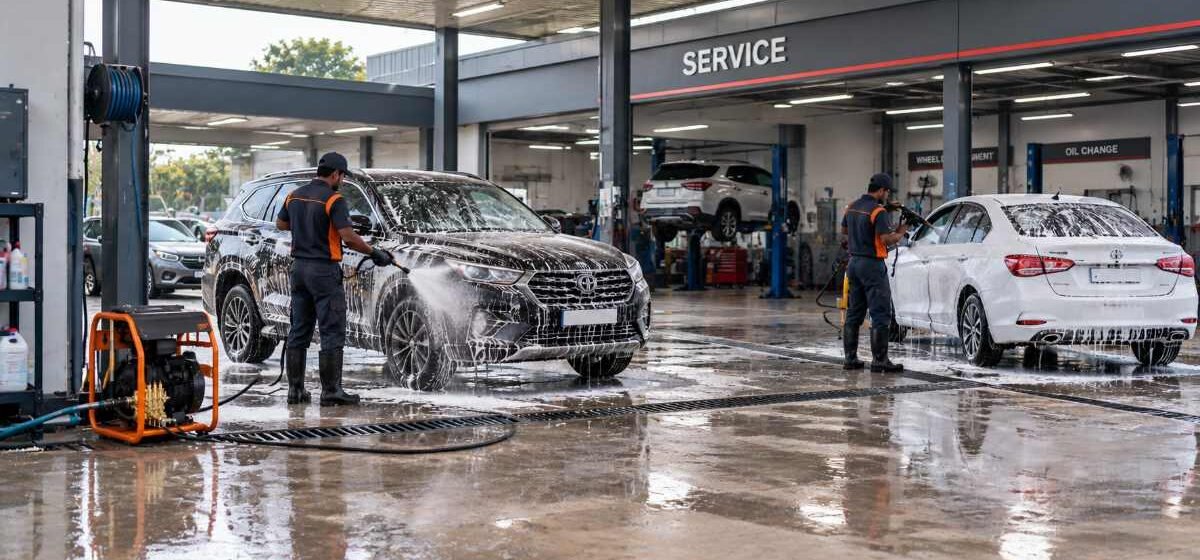
A forecourt wash bay lives or dies on cycle time. If your attendant takes eighteen minutes per car and the queue builds past three vehicles, drivers pull out and refuel somewhere else. Picking a Car Wash Machine for Service Stations is really a decision about how many minutes you can shave off each wash without wrecking the machine inside a year. SGT Multiclean Equipments can help you evaluate the right equipment for your service station’s workload.
Service station bays are a harsher environment than most buyers expect. Long hours, untrained operators, dust, monsoon mud and back-to-back cycles with barely a pause. The specification that works for a standalone detailing studio will not survive here. SGT Multiclean Equipments offers equipment options designed for demanding service station cleaning requirements.
What “High Volume” Actually Means on a Forecourt
Anything above 40 vehicles a day counts as high volume in Indian conditions. Past 70, you’re in a different equipment class altogether. The number that matters more than the daily total is peak concentration: 60 cars spread evenly across twelve hours is manageable, while 60 cars arriving between 8 a.m. and noon is not.
Map your own pattern for a week before you buy. Count vehicles by hour, note the mix of hatchbacks, SUVs and light commercials, and record how long a wash actually takes today. That data drives every specification decision below.
Specifications That Decide the Right Car Wash Machine for Service Stations
Flow rate matters more than headline pressure
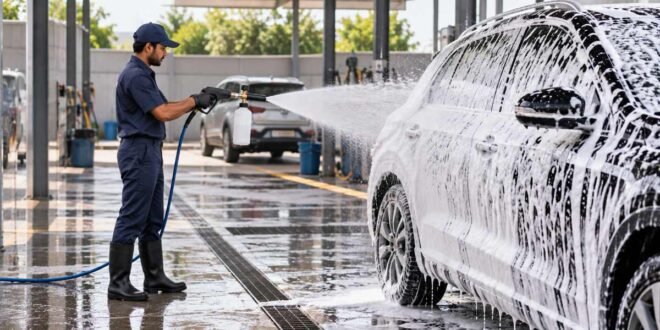
Buyers fixate on bar. Flow rate in litres per minute is what determines rinse speed on any Professional Car Wash Machine. A 150 bar machine at 15 LPM will finish a mud-caked SUV faster than a 200 bar machine at 8 LPM, because pressure loosens dirt but water volume carries it off the panel. For forecourt work, look for 12 to 15 LPM as a floor. Anything below 10 LPM turns rinsing into the bottleneck.
Duty cycle, pump and cooling
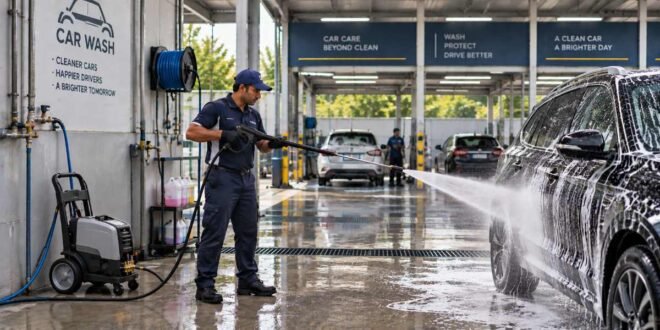
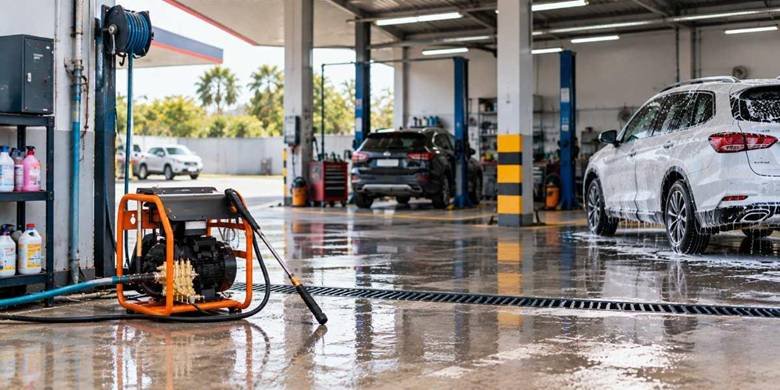
A Professional Car Wash Machine intended for continuous use runs a triplex plunger pump with a brass or forged head, ceramic-coated pistons and a proper crankcase oil bath. Ask for the rated duty cycle in hours per day and treat anything under six hours as unsuitable. Motor cooling matters too. A slow-speed induction motor at 1450 rpm runs cooler and lasts far longer than a 2800 rpm unit doing the same job.
Power supply and site electricals
Most serious High Volume Car Wash Equipment needs a three-phase connection. A 5.5 to 7.5 kW machine on three-phase gives you the flow and the thermal headroom that a single-phase unit simply can’t. Check your sanctioned load before ordering, and budget for proper cabling, an MCB panel and earthing. IP55 protection or better is sensible in a wet bay.
Machine Types Compared
| Type | Typical Throughput | Staff Needed | Indicative Cost (INR) |
| Single high-pressure washer | 20–30 cars/day | 2 | 90,000 – 2,20,000 |
| Twin-outlet or multi-gun washer | 40–60 cars/day | 3 | 2,50,000 – 4,50,000 |
| Hot-water pressure washer | 30–45 cars/day | 2 | 2,50,000 – 5,50,000 |
| Semi-automatic bay with lift | 50–70 cars/day | 3 | 6,00,000 – 12,00,000 |
| Automatic rollover | 80–150 cars/day | 1–2 | 18,00,000 – 45,00,000 |
Rollovers look attractive on paper. They also demand consistent volume, a level bay of the right dimensions, reliable power and water treatment. Plenty of stations have bought one and run it at a third of capacity. A well-specified manual bay with two trained operators often earns more per rupee invested.
Hot Water or Cold Water for a Commercial Car Wash Machine
Hot water is genuinely faster on grease, road film and engine bays, typically cutting chemical dwell time and the amount of scrubbing needed. It also costs more to buy and run, since you’re feeding a diesel or electric boiler.
For a forecourt that washes mostly passenger cars, a cold-water Commercial Car Wash Machine paired with good foam chemistry handles the work. If you also service trucks, tractors, tempos or taxi fleets with heavy underbody soiling, hot water pays for itself faster than most owners expect. Some stations compromise by keeping one hot-water unit for heavy jobs and cold-water lances for routine washes.
Layout, Water and Drainage
Water supply and quality
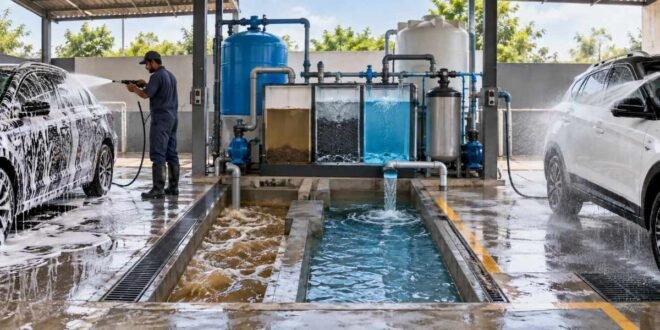
Hard borewell water is common across Bangalore, Chennai and much of peninsular India, and it will scale the pump head, nozzles and any heating coil. A softener or basic treatment upstream of your Service Station Washing Equipment is cheap insurance. Also size the storage: at 70 to 120 litres per vehicle, a 60-car day moves several thousand litres you need buffered.
Drainage and effluent
Every wash bay needs a graded floor, a collection channel and an oil and grease interceptor before anything reaches the drain. Pollution control expectations for forecourt washes have tightened, and a recycling plant recovering 60 to 80 percent of wash water is increasingly part of the plan rather than an upgrade. Retro-fitting drainage after the civil work is done is painful and expensive.
Matching a Car Wash Machine for Service Stations to Daily Throughput
• Under 30 cars a day: one heavy-duty cold-water washer at 150 bar and 15 LPM, a foam tank and a commercial wet-dry vacuum.
• 30 to 60 cars a day: a twin-outlet machine or two separate units so wash and rinse run in parallel, plus a lift for underbody work.
• 60 to 100 cars a day: semi-automatic bay, dedicated foam system, water recycling and at least three staff on the wash line.
• Above 100 cars a day: rollover or tunnel, with a manual bay retained for premium and detailing jobs.
The step from one machine to two is usually the highest-return move a station makes. It removes the single point of failure. When your only Vehicle Washing Machine goes down on a Sunday morning, you lose the day’s best revenue window entirely.
Maintenance and Uptime for Service Station Washing Equipment
Machines at service stations rarely fail from age. They fail from neglect and misuse. The recurring causes are dry running when the water supply drops, worn nozzles that quietly kill pressure, unfiltered inlet water chewing valves, and hoses damaged by being driven over.
Build a simple routine: check inlet filters weekly, replace nozzles when spray pattern widens, change pump oil at the interval in the manual, and drain the system if the bay is unused for long stretches. Keep a spares kit on site with O-rings, a trigger gun, a spare lance and one high-pressure hose. A machine sitting idle waiting for a Rs 400 seal kit is the most avoidable loss in this business.
Frequently Asked Questions
What pressure rating should a Car Wash Machine for Service Stations have?
For passenger vehicles, 130 to 160 bar is the practical sweet spot. Higher pressure risks paint and trim damage in untrained hands without washing meaningfully faster. Prioritise flow rate of 12 to 15 LPM alongside that pressure, because water volume is what actually clears loosened dirt from panels quickly.
Is an automatic rollover worth it for a fuel station?
Only with consistent high volume, generally 80 or more vehicles a day, plus adequate bay dimensions, stable three-phase power and water treatment. Below that, the capital sits idle. Many stations get better returns from two manual bays and trained staff, which also handle irregular vehicle shapes far better.
How much water does a forecourt wash bay use per car?
Expect roughly 70 to 120 litres per passenger vehicle with a high-pressure lance, against several hundred with an open hose. Larger vehicles and heavy soiling push a Vehicle Washing Machine higher still. A recycling system typically recovers a large majority of that, which matters where municipal supply is limited or costly.
Can single-phase equipment handle a busy service station?
Rarely. Single-phase units usually cap out around 3 kW, which limits flow rate and thermal headroom for continuous duty. They overheat during back-to-back cycles and wear quickly. If your sanctioned load allows it, three-phase High Volume Car Wash Equipment is the more economical choice over any realistic ownership period.
Conclusion
The right Car Wash Machine for Service Stations is the one matched to your actual hourly demand, your water quality and the skill level of the people operating it. Chase flow rate and duty cycle before headline pressure. SGT Multiclean Equipments can help you evaluate equipment based on your service station’s operational requirements. Insist on a triplex pump and a serviceable spares supply. Plan drainage, water treatment and electricals as part of the project rather than afterthoughts, because retrofitting them costs far more than doing them once. And be honest about volume, since the most common expensive mistake is buying automation for a forecourt that will never fill it.
If you’re weighing up your options, talking through your site conditions and vehicle mix with an experienced equipment team like SGT Multiclean Equipments is the quickest way to get a specification that fits.