 ₹ INR


March in Bangalore, the borewell yield drops, and suddenly you’re paying tanker rates to wash cars. Anyone running a bay through a dry season knows the feeling. A Car Wash Water Recycling System stops that from being an annual crisis by turning most of yesterday’s wash water into today’s supply. SGT Multiclean Equipments can help you evaluate suitable water recycling solutions for your car wash operation.
The economics have shifted too. Municipal supply is tighter, tanker prices climb steeply in summer, and pollution control boards are far more interested in what leaves your drain than they were a decade ago. Recovery has moved from a nice-to-have into standard equipment for any bay handling real volume. SGT Multiclean Equipments offers equipment options to support efficient water recovery and reuse.
Why Water Became the Real Constraint
A high-pressure lance uses roughly 70 to 120 litres per passenger car. That already beats an open hose by a wide margin, but at 50 cars a day you’re still consuming four to six thousand litres. Add SUVs, commercial vehicles and detailing work and the number climbs.
In peninsular India the constraint bites twice. Supply gets scarce between February and May, and the water you do get is often hard borewell water that scales pump heads and nozzles. Water Saving Car Wash Equipment solves only half of it. Discharge is the other half, because raw wash effluent carries oil, detergent, silt and heavy metal traces that shouldn’t reach a storm drain.
How a Car Wash Water Recycling System Actually Works
A Car Wash Water Recycling System is a sequence of stages, not a single machine. Each stage removes a different contaminant, and skipping one shows up as odour, staining or spotting on paintwork.
Collection, settling and oil separation
Wash water drains into a graded channel and enters a settling chamber, usually two or three baffled compartments. Heavy silt drops out. An oil and grease interceptor skims floating hydrocarbons before they reach anything downstream. This stage does more work than people credit. If your interceptor is undersized, every filter after it clogs early.
Car Wash Water Treatment stages
From there water passes through progressively finer media. A typical Car Wash Water Treatment train starts with a sand or multigrade filter for suspended solids, then activated carbon for dissolved organics, detergent residue and colour. Some systems add a bag or cartridge filter down to 20 or 5 microns before the recovered water returns to the pump.
Dosing, disinfection and storage
Recycled wash water sitting in a tank will go anaerobic and smell within a couple of days. Chlorine dosing, ozone injection or UV treatment prevents that. Recovered water is then stored separately from fresh water, because the final rinse should always use fresh or softened supply to avoid spotting.
What Gets Recovered, and What Doesn’t
A well-designed Car Wash Water Recycling System typically returns 60 to 85 percent of your wash water. The remainder is lost three ways: evaporation, water carried away on the vehicle, and the sludge and backwash you periodically remove.
That last figure is the one suppliers gloss over. Filter backwashing consumes water. Sludge from the settling pit needs clearing every few weeks depending on how muddy your local roads get. Plan for both rather than assuming a closed loop with zero make-up water, because that system doesn’t exist.
Sizing a Car Wash Water Recycling System to Your Bay
| Daily Volume | Suggested Capacity | Approx. Footprint | Indicative Cost (INR) |
| 20–35 cars | 2,000–3,000 LPD | 6–8 sq m | 1,80,000 – 3,50,000 |
| 35–60 cars | 3,000–5,000 LPD | 8–12 sq m | 3,50,000 – 6,00,000 |
| 60–100 cars | 5,000–8,000 LPD | 12–20 sq m | 6,00,000 – 9,50,000 |
| 100+ cars or tunnel | 10,000+ LPD | 20+ sq m | 9,50,000 upward |
Treat these as indicative. Actual quotations move with recovery percentage targeted, automation level, tank material and whether civil work is included. Undersizing is the common error. A plant running at its ceiling every day gives you shorter filter life and falling water quality.
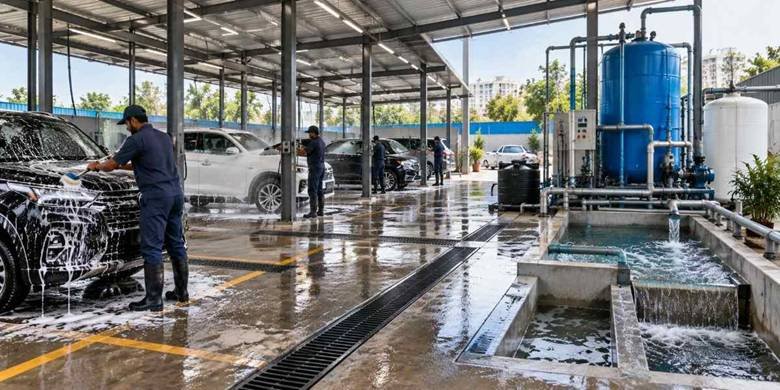
Costs, Payback and Running Expenses
Payback on Car Wash Water Recycling depends almost entirely on what you currently pay for water. If you’re on cheap municipal supply at low volume, the maths is slow. If you’re buying tankers for three months a year at peak rates, Water Recycling for Car Wash operations often pays back within two to four years.
Running costs are modest but real:
• Electricity for transfer pumps and blowers, typically a fraction of what the pressure washers draw
• Filter media replacement, usually carbon every 12 to 24 months and sand less often
• Dosing chemicals or UV lamp replacement
• Periodic sludge removal and disposal
• An annual service visit to check flow rates and backwash cycles
There’s a second benefit that rarely appears in a spreadsheet. Consistent water availability means you don’t turn customers away in April, which for a busy bay is worth more than the litres saved.
Installation Realities
Retrofitting a Car Wash Water Recycling System is harder than new build, and the difference is civil work. A new bay can be laid with the correct floor slope, a collection channel across the entrance and an underground settling pit from day one. Retrofitting means breaking existing flooring, which is disruptive and expensive.
Space is the other constraint, and urban forecourts rarely have a spare corner for Water Recycling for Car Wash bays. Modular skid-mounted units help, and some plants can go partly below ground, but you still need access for filter servicing and sludge clearing. Check headroom above tanks before you sign anything.
Power is straightforward, generally single-phase for small plants and three-phase for larger ones, but do include the plant load when you calculate your sanctioned demand alongside the rest of your Water Saving Car Wash Equipment.
Maintenance That Keeps Vehicle Wash Water Recovery High
Most disappointing installations aren’t badly designed. They’re badly maintained. Vehicle Wash Water Recovery drops off quietly, nobody notices for six months, and then the water starts smelling.
1. Clear the settling pit on schedule, not when it overflows.
2. Backwash filters at the recommended frequency and log it.
3. Check the oil interceptor weekly and skim it.
4. Replace carbon media before breakthrough, not after complaints.
5. Test recycled water periodically for odour, turbidity and residual chlorine.
Keep the final rinse on fresh water. It’s tempting to close the loop completely, but recycled water carries dissolved solids that leave marks on dark paint, and one unhappy customer with a spotted bonnet undoes a lot of goodwill.
Frequently Asked Questions
How much water can a Car Wash Water Recycling System actually save?
Most well-specified plants recover between 60 and 85 percent of wash water. The exact figure depends on filtration stages, vehicle soiling levels and how much water leaves on the car itself. Aim for realistic vendor claims. Anyone promising near-total recovery without make-up water is overselling the system.
Will recycled water damage vehicle paint?
Not if the system is designed properly and the final rinse uses fresh or softened water. Problems appear when recycled water with high dissolved solids is used for rinsing, leaving spots on dark finishes. Adequate filtration, disinfection and a fresh-water final rinse together prevent almost every complaint of this kind.
Is Car Wash Water Recycling mandatory in India?
Requirements vary by state and by local pollution control board, and larger commercial washes face closer scrutiny than small bays. Rules have been tightening steadily. Check current expectations with your state board before designing the bay, and treat compliance as a design input rather than a later addition.
How long does a recycling plant take to pay for itself?
Usually two to four years for a bay washing 50 or more vehicles daily, faster where tanker water is expensive or supply is unreliable. Below about 30 cars a day, payback stretches considerably. Factor in avoided downtime during dry months, since that revenue protection is often the larger benefit.
Conclusion
A Car Wash Water Recycling System is best understood as infrastructure rather than an accessory. Size it to a genuine daily volume with headroom, insist on proper settling and oil separation before filtration, keep the final rinse on fresh water, and commit to the maintenance schedule from the first week. Get those four things right and Vehicle Wash Water Recovery becomes invisible, which is exactly what you want. Get them wrong and you’ll have an expensive tank of smelly water and a bay that still runs dry in April. SGT Multiclean Equipments can help you assess suitable water recycling solutions for your car wash operation. Ask any supplier for recovery figures you can verify on site, and check what a service visit actually covers before you sign.
If you’re weighing up your options, walking an experienced equipment team like SGT Multiclean Equipments through your site layout, water source and daily volume is the fastest route to a system that suits your bay.