 ₹ INR

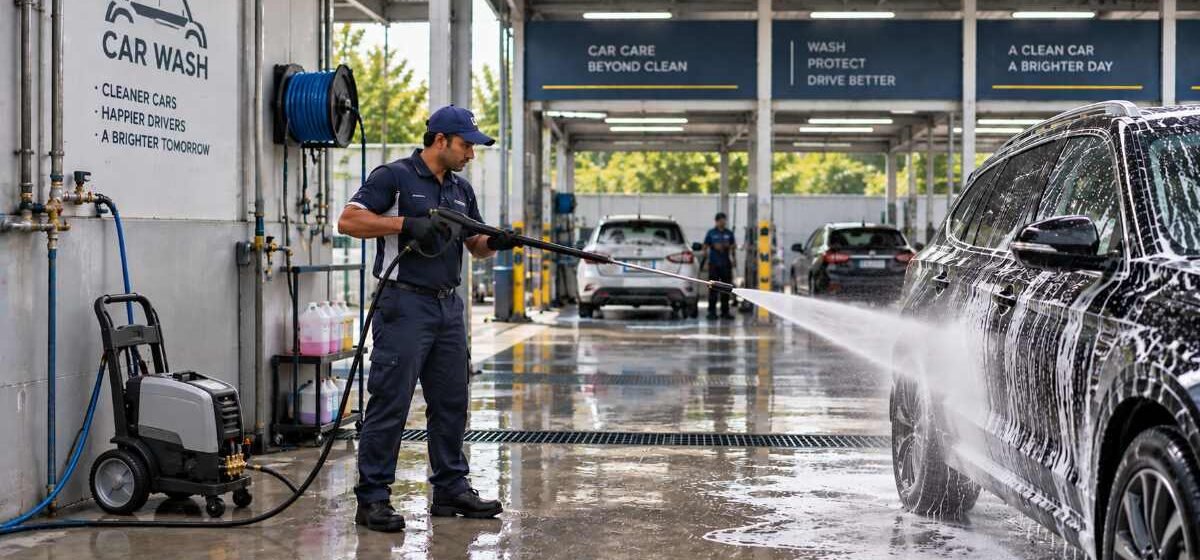
It’s 8 a.m. on a Monday in Bangalore and there are four cars queued outside your bay. Whether you clear them in thirty minutes or ninety comes down entirely to what you bought a year ago. That’s why the Car Wash Equipment Price question is never just about the invoice. It’s about how many vehicles each rupee of capital can turn out per day. SGT Multiclean Equipments can help you evaluate equipment based on your car wash operation and expected workload.
Most owners walk in with a figure already in their head. Two lakh, maybe five. The honest range for a working setup runs from about Rs 1.5 lakh for a lean single bay to well past Rs 25 lakh for an automated one. Here’s where that money goes. SGT Multiclean Equipments offers equipment options to suit different car wash setups and operational requirements.
What Actually Drives Car Wash Equipment Price
Two pressure washers can look identical on a spec sheet and differ threefold in cost. The gap sits in components you can’t see from the showroom floor.
Duty cycle and pump construction
A domestic-grade washer uses an axial wobble-plate pump rated for 30 to 60 minutes a day. A commercial triplex plunger pump with a forged brass head and ceramic pistons is built for six to eight hours of continuous duty. That difference explains much of any Car Wash Equipment Price gap. Buy the domestic unit for a commercial bay and you’ll replace it twice in a year.
Motor rating, power supply and water temperature
Induction motors outlast universal motors but cost more upfront. A 3 kW single-phase cold-water machine is a different animal from a 7.5 kW three-phase hot-water unit with a boiler. Hot water strips grease fast, and it roughly doubles the Car Wash Equipment Cost of the primary machine, so only pay for it if your vehicle mix justifies it.
Indicative Car Wash Machine Price by Category
Treat the figures below as indicative. Quotes shift with specification, motor rating and bundled accessories.
| Equipment | Typical Spec | Indicative Range (INR) |
| Entry commercial pressure washer | 120–150 bar, 8–10 LPM, 2.2–3 kW | 35,000 – 70,000 |
| Heavy-duty cold-water washer | 150–200 bar, 12–15 LPM, 5.5–7.5 kW, 3-phase | 90,000 – 2,20,000 |
| Hot-water pressure washer | 150 bar, 12 LPM, with boiler | 2,50,000 – 5,50,000 |
| Foam generator / foam tank | 24–50 litre, stainless | 12,000 – 45,000 |
| Two-post hydraulic lift | 3.5–4 tonne capacity | 1,60,000 – 3,20,000 |
| Wet and dry vacuum, commercial | 60–80 litre, twin motor | 25,000 – 65,000 |
| Water recycling plant | 3,000–8,000 LPD | 3,50,000 – 9,00,000 |
| Automatic rollover system | Brush or touchless | 18,00,000 – 45,00,000 |
The spread inside each row is real. A 150 bar machine with a plastic pump head and one with a forged brass head are not the same purchase, even though the Car Washing Machine Price looks comparable on a listing page.
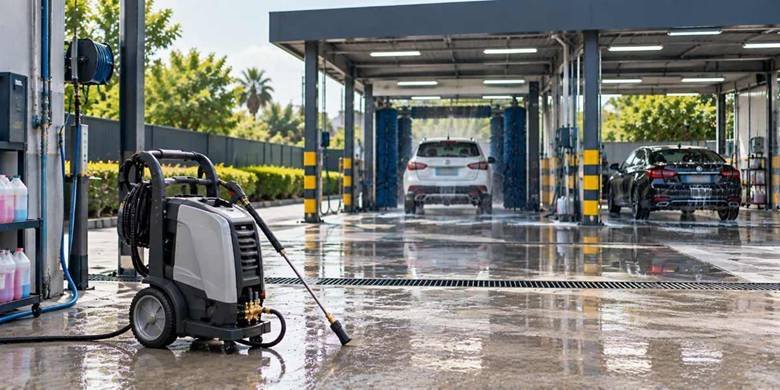
Professional Car Wash Setup Cost by Format
Single-bay manual wash
One heavy-duty cold-water washer, a foam tank, a wet-dry vacuum, hoses, lances and a modest tool kit. Budget roughly Rs 1.5 lakh to Rs 3 lakh. Realistic throughput is 20 to 30 cars a day with two staff, and the format works well if your rent is sensible.
Two-bay wash with detailing
Add a second washer, a hydraulic lift for underbody work, a polisher set, steam cleaner and better vacuums. Equipment lands around Rs 5 lakh to Rs 9 lakh. Detailing is where the margin lives, so the extra Car Wash Equipment Price here usually pays back faster than a bigger washer would.
Automatic or semi-automatic bay
Rollover systems, conveyor tunnels and their water treatment push the Professional Car Wash Setup Cost past Rs 20 lakh. These only make sense at 80-plus cars a day, which in practice means a fuel-station forecourt or a busy arterial road.
Line Items Owners Forget to Budget
The machine quotation is rarely the full Car Wash Equipment Cost. Plan for these before you commit:
• Civil work: bay flooring with correct slope, drainage channel, oil and grease trap
• Electrical: three-phase connection, cabling, MCB panel, earthing
• Water: sump, overhead tank, softener if your borewell water is hard
• Consumable stock: shampoo, foam concentrate, wax, microfibre, brushes
• Spares kit: nozzles, O-ring sets, high-pressure hose, trigger gun
• Compressor for air blowing and pneumatic tools
In Bangalore and much of South India, hard borewell water is the quiet budget killer. Scale builds in the pump head and nozzles, flow drops, and you blame the machine. A softener costs far less than a pump rebuild.
Running Costs After the Invoice
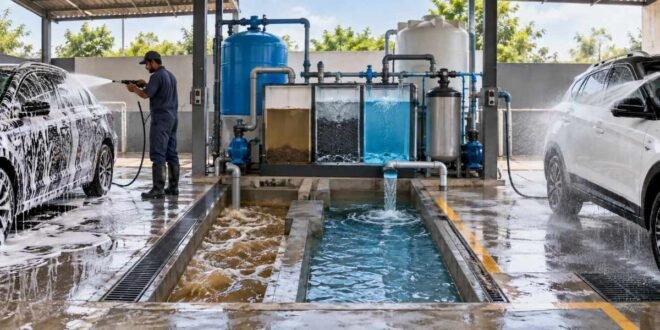
A 7.5 kW three-phase washer running near full load for six hours a day is a meaningful monthly electricity line. Water is the other. A good lance uses far less than a hose, but at 60 to 100 litres per car and 25 cars a day you’re still moving thousands of litres. That’s why recycling appears in most Car Wash Business Investment plans past 40 cars a day.
Consumables run roughly Rs 20 to Rs 60 per vehicle. Labour is usually your largest recurring cost, and better equipment trims it by cutting minutes per car.
Judging Value, Not Just Car Wash Equipment Price
The cheapest quote is almost never the cheapest outcome. Ask these questions before you compare any two numbers:
1. What is the rated duty cycle in hours per day?
2. Is the pump head brass or aluminium, and are pistons ceramic?
3. Is a spares kit stocked locally, and what is the typical lead time?
4. Who services it, and what is the response window?
5. What is the flow rate in LPM, not just the pressure in bar?
That last point catches people out. Pressure removes bonded dirt. Flow carries it away. A 200 bar machine at 8 LPM feels slower on a muddy SUV than a 150 bar unit at 15 LPM, and Car Wash Machine Price often tracks flow more honestly than pressure.
Sizing Your Investment to Your Volume
Match capital to realistic demand, not aspiration. Under 25 cars a day, one solid cold-water washer and good accessories beats anything fancy. Between 25 and 60, add a second bay and a lift before considering automation. Only past 60 consistently does a rollover system’s Car Wash Equipment Price look defensible against the labour it replaces.
Phasing helps. Buy the washer and vacuum first, run six months, then fund the lift and recycling plant from cash flow. It softens the Car Wash Business Investment curve and lets demand tell you what to buy next.
Frequently Asked Questions
What is a realistic Car Wash Equipment Price for a small startup?
For a single-bay operation, budget roughly Rs 1.5 lakh to Rs 3 lakh for equipment alone. That covers a heavy-duty pressure washer, foam tank, commercial vacuum, hoses and basic tools. Civil work, electrical connection and initial consumables sit outside that figure and typically add another Rs 1 lakh to Rs 2 lakh.
Is a hot-water pressure washer worth the extra cost?
Only if your vehicle mix demands it. Hot water strips grease and oil far faster, which suits truck fleets, engine bays and workshop floors. For passenger cars in a retail wash, cold water with good foam chemistry does the job at a fraction of the Car Washing Machine Price.
How long does commercial car wash equipment last?
A properly specified commercial washer used within its duty cycle typically runs five to eight years with routine servicing. Pumps need seal kits periodically, nozzles wear out and hoses need replacement. Undersized machines pushed beyond their rating often fail within eighteen months, which is the most common costly mistake.
Does a water recycling system reduce overall costs?
At higher volumes, usually yes. Once you’re washing 40 or more cars daily, recovered water offsets both supply cost and discharge issues, and it helps with local regulatory expectations. Below that volume, the payback period stretches out and the capital is often better spent on throughput.
Conclusion
Getting the Car Wash Equipment Price right is less about the lowest quote and more about matching duty cycle, flow rate and format to the cars you’ll genuinely wash each day. SGT Multiclean Equipments can help you match equipment to your expected daily workload. Undersize the machine and you pay in downtime and replacements. Oversize it and you’ve locked up capital that would have earned more as a second bay. Work backwards from realistic daily volume, budget civil and electrical work honestly, and treat spares and consumables as part of the plan rather than a surprise. A phased build usually beats a single large purchase, because six months of real customer demand tells you more than any projection you write today.
If you’re weighing up your options, speaking with an experienced local equipment team like SGT Multiclean Equipments is the fastest way to get specifications matched to your site and your vehicle mix.