 ₹ INR
₹ INR
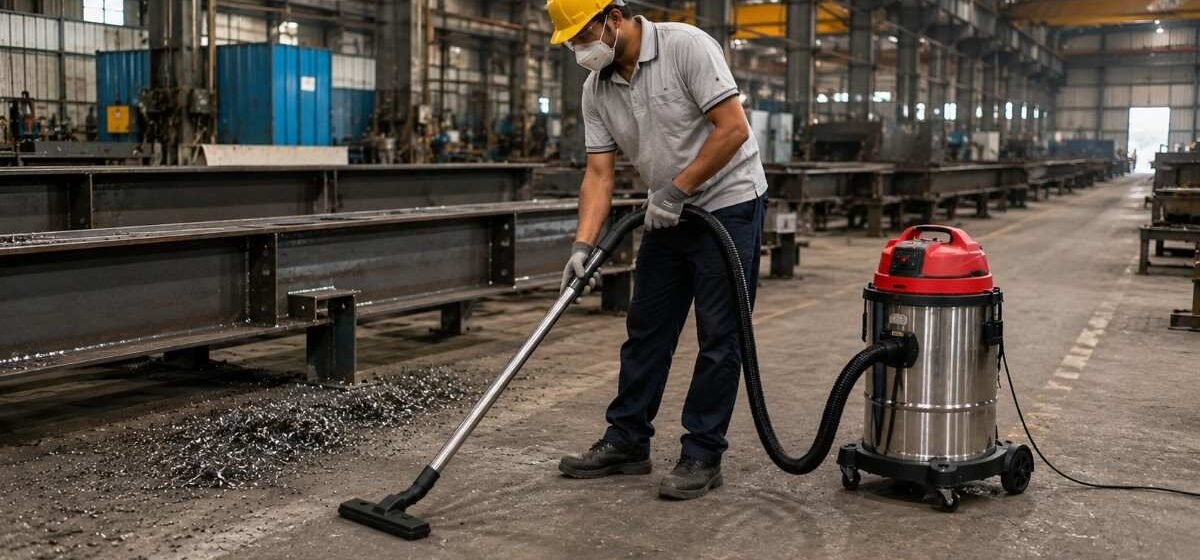
The first sign that a plant has the wrong machine is a vacuum parked in a corner with a torn hose and a filter nobody has touched since installation. It happens constantly. Someone bought on price, the unit couldn’t cope with eight hours of swarf and fines, and the team went back to brooms and compressed air. Picking an industrial vacuum cleaner for manufacturing is less about headline power and more about whether the machine can survive the way your floor actually works. SGT Multiclean Equipments can help you assess the right equipment for demanding manufacturing environments.
Debris in a production environment is abrasive, sometimes hot, often mixed with coolant, and it never arrives in convenient amounts. The specification has to reflect that or it becomes shelf furniture within a year. SGT Multiclean Equipments offers guidance on matching industrial vacuum equipment to the demands of the production floor.
What Manufacturing Dust Does If You Leave It
Airborne fines settle into linear guides, encoder windows and contactor panels. Metallic dust bridges terminals. Fine powder loads air filters on drives and pushes cabinet temperatures up until thermal trips start appearing on the shift log. None of that shows as a single dramatic failure, which is why it gets ignored until a machine goes down in a busy week.
There’s a compliance side too. Housekeeping is one of the first things a customer audit looks at, and visible dust on ledges undermines everything else you’re showing them. An industrial vacuum cleaner for manufacturing areas is cheaper than the shutdown it prevents, and considerably cheaper than a repeat audit. Good industrial dust collection is quietly a maintenance strategy.
Choose an Industrial Vacuum Cleaner for Manufacturing by Process, Not Catalogue
Machining, grinding and fabrication
Swarf, grinding grit and coolant mist demand a steel container, a cyclonic pre-separator and a hose of at least 50 mm. Wet capability matter here because coolant comes with the chips. Expect to need genuine heavy duty industrial suction, in the region of 2,500 to 3,000 mm H₂O with 300 m³/h or more, to keep long chips moving up a 10-metre hose.
Plastics, packaging and assembly
Lighter debris, but a lot of it: offcuts, film scraps, granules from hopper spills. Airflow matters more than vacuum, and an antistatic hose stops granules clinging to the inside of the tube. Container volume is usually the limiting factor, so size for a full shift rather than an hour.
Food, pharma and clean processes
Here filtration is the specification. H13 HEPA on the exhaust, stainless contact surfaces, and a bag-out discharge so emptying doesn’t release what you just captured. Manufacturing dust extraction in these plants also has to be documented, so pick a machine whose filter class you can point to on paper.
Textiles, wood and fibrous material
Lint and fiber blind filters faster than anything else. Look for a large filter area, a shaker or jet-pulse cleaning system, and easy access for the operator to pull matted fiber off the cartridge without tools. Manufacturing dust extraction on fibrous material lives or dies on filter maintenance.
Specifications Worth Arguing About in a Factory Vacuum Cleaner
Airflow, vacuum, and why wattage misleads
Airflow in m³/h moves material along the hose; vacuum in mm H₂O lifts it off the floor. A factory vacuum cleaner needs a sensible balance of the two, because both come from the same blower and a high figure in one usually means a compromise in the other. General floor and machine cleaning wants a balance, roughly 2,000 to 2,800 mm H₂O with 300 to 400 m³/h. Point extraction at a single tool wants high vacuum and low flow. Wattage tells you neither, and comparing quotes on kW alone is how plants end up disappointed.
Filter area and class
Filter area in m² is the number that predicts how long suction stays healthy. Two identical motors with 1 m² and 4 m² of cartridge behave completely differently by hour three. Class M covers most general manufacturing dust; class H is for hazardous or carcinogenic material and should be specified with input from a qualified safety professional.
Continuous Duty: What an Industrial Vacuum Cleaner for Manufacturing Must Handle
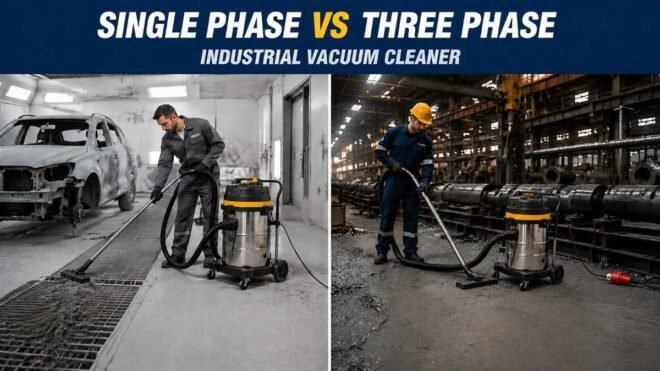
A brushed bypass motor is rated for intermittent use, typically 20 to 30 minutes at a stretch. A three-phase side-channel blower is rated for continuous running and will hold up to a full shift, every shift. If your machine is going to run more than about two hours a day, three-phase pays for itself in avoided motor replacements alone.
Check the supply before you order. Plenty of older Indian sheds have three-phase at the panel but only single-phase sockets near the work area, and running a new circuit can add ₹10,000 to ₹30,000 that nobody budgeted for.
Portable, Fixed or Both: Where a Production Floor Vacuum Belongs
| Plant situation | Best fit | Why |
| Multiple bays, roaming maintenance | Portable production floor vacuum, 3-phase | Follows the work across several cells |
| One heavy dust source | Fixed unit with ducting | Continuous capture at the source |
| Mixed dry and coolant | Wet-and-dry industrial unit | Float cut-off and drain handle both |
| Clean process area | Stainless, HEPA, bag-out | Containment and documentation |
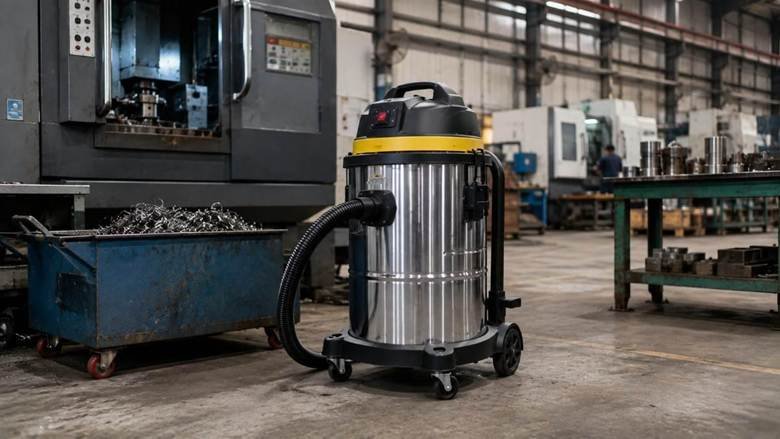
Most mid-sized plants start with one portable industrial vacuum cleaner for manufacturing areas, discover which process generates the real mess, and buy a second dedicated unit for it within the year. That sequence works better than guessing at a central system on day one.
Budget, Payback and What It Costs to Run
Indicative ranges: a heavy single-phase factory vacuum cleaner suitable for a small unit generally falls between ₹70,000 and ₹1.5 lakh. Three-phase machines from 3 to 5.5 kW with cyclonic separation and cartridge filtration typically sit between ₹1.5 lakh and ₹3.5 lakh. Stainless or hazardous-area builds go well beyond that, and every figure shifts with accessories, filter class and freight. Heavy duty industrial suction costs more up front and less per running hour.
Running costs are dominated by consumables. Budget for a cartridge every six to eighteen months on abrasive dust, plus hoses, which wear at the cuff long before the tube fails. An industrial vacuum cleaner for manufacturing that costs 40% more but doubles cartridge life often works out cheaper across five years.
Getting the Machine Actually Used
• Put the machine where the mess is, not in the store room.
• Give one shift supervisor ownership of filter checks.
• Keep a spare hose and cartridge on site so a small failure doesn’t stop use.
• Train operators on wet mode: dry cartridges must come out first.
• Empty at two-thirds full, not when it stops picking up.
Every plant that gets long service from an industrial vacuum cleaner for manufacturing does these five things. Every plant with a dead machine in the corner skipped at least three of them.
Frequently Asked Questions
How do I size an industrial vacuum cleaner for manufacturing floor cleaning?
Work backwards from hours and material. For two to four hours a day of general dry debris, a 2 to 2.4 kW single-phase machine with a cartridge filter is usually enough. Beyond four hours, or with abrasive and coolant-laden waste, move to a three-phase unit with cyclonic pre-separation and a 100-litre container.
Can one machine handle swarf, coolant and fine dust?
A well-specified wet-and-dry industrial vacuum cleaner for manufacturing can, provided you swap or remove the dry filter before wet pickup and clean the container between materials. Mixing fine dust with coolant residue creates a paste that blocks filters quickly, so many plants prefer separate machines once volumes rise.
Is a central system better than portable units?
Only when you have one dominant, fixed dust source. Central industrial dust collection removes the machine from the floor and suits bagging lines or dedicated cells. For plants with varied work across several bays, portable units cost far less and stay useful when the layout changes.
How often should filters be cleaned?
On a schedule, not on symptoms. Daily shaker cleaning or automatic jet-pulse cycles for heavy dust, weekly inspection for lighter loads, and replacement when cleaned suction no longer returns to normal. Waiting for visible suction loss means the motor has already been running hot for weeks.
Conclusion
The best industrial vacuum cleaner for manufacturing is rarely the most powerful one in the brochure. It’s the one matched to your material, your running hours and your electrical supply, with enough filter area to hold performance through a full shift and spares supply you can rely on. Start with the process that makes the worst mess, specify for that honestly, and treat consumables as part of the purchase rather than a surprise. A properly sized machine changes how a plant looks within a fortnight, and how it runs within a quarter. SGT Multiclean Equipments can help you identify a machine specification that aligns with your production requirements.
If you’re comparing options, talking through your actual processes with an experienced supplier like SGT Multiclean Equipments is the quickest way to land on a specification that fits.