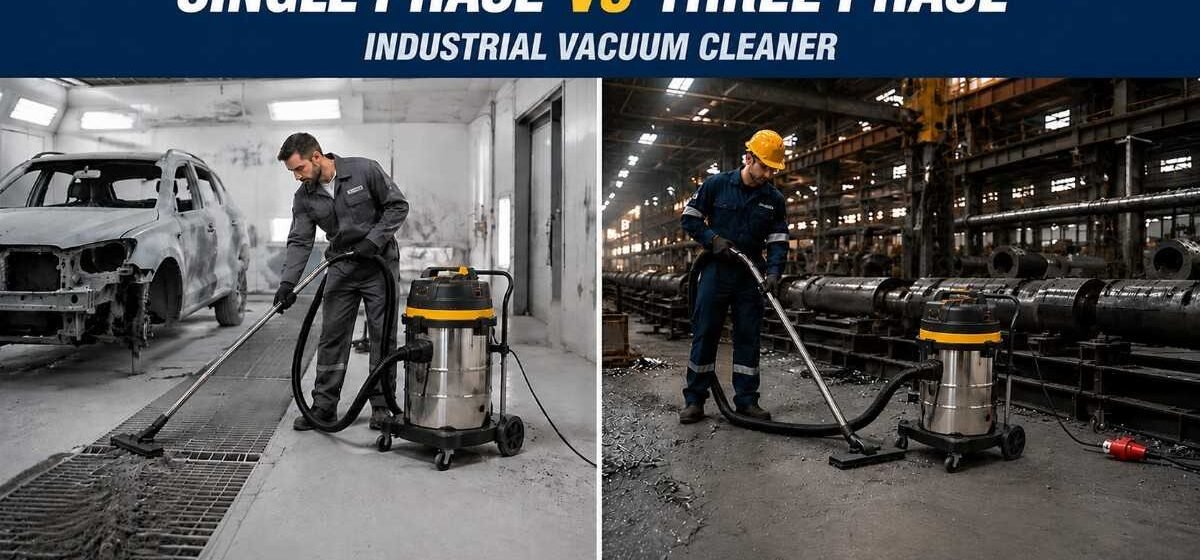

The question usually arrives late in the buying process, after the tank size and hose diameter are settled. Someone in maintenance asks what supply the machine needs, and suddenly the quote has a cable run and an isolator in it. SGT Multiclean Equipments can help you consider the electrical requirements early, so the machine specification fits the site properly. Single Phase vs Three Phase Industrial Vacuum Cleaner isn’t really a debate about power ratings. It’s a question about how many hours a day the machine will run, and who has to wire it in.
Both types clean well. Single Phase vs Three Phase Industrial Vacuum Cleaner really comes down to how each one fails, and the wrong pick shows up six months later as a burnt motor or a cable snaking across a gangway. SGT Multiclean Equipments can help you assess the duty cycle and electrical setup before selecting the appropriate machine.
What “Phase” Actually Means on Your Floor
A single-phase supply gives you one live conductor and a neutral, usually at 230V through a 16A socket. Three-phase gives you three live conductors at 415V, delivering power in overlapping cycles rather than one pulsing wave. The practical result is smoother torque and less heat in the motor windings for the same output.
That difference matters most under sustained load. A single-phase motor works harder to hold speed as the filter loads up and the airflow drops. A three-phase induction motor barely notices. It’s the same reason your compressor and your lathe are almost certainly on three-phase while the pedestal fan isn’t.
Single Phase Vacuum Cleaner: Where It Earns Its Place
A single phase vacuum cleaner suits intermittent work. Housekeeping between shifts, cleaning a machine bed after a job, clearing a spill, vacuuming a hotel back-of-house corridor. Motors are typically 1.2 to 3.6 kW, often twin or triple bypass motors ganged together, and the whole thing plugs into a socket you already have.
The advantages are practical rather than technical. You can move the industrial vacuum machine to a new building without calling an electrician. It costs less up front. Spares are cheap and widely stocked. For a facility that vacuums for an hour a day, that’s the sensible answer and there’s no prize for overbuying.
The limits are real, though. Carbon brushes wear, typically needing replacement after a few thousand hours. Run the machine six hours straight in a Bangalore summer and the housing gets hot enough that you’ll want a break in the schedule. You’ve outgrown a single-phase commercial vacuum cleaner when:
• The motor is hot to touch at the end of every shift
• You’re replacing brushes more than twice a year
• Two operators are running two machines to cover one area
• The unit trips the MCB when the filter starts loading
Three Phase Vacuum Cleaner: Built for Continuous Duty
A three phase vacuum cleaner usually uses a side-channel blower rather than a bypass motor. There are no brushes to wear. The unit is designed to run for thousands of hours without stopping, which is why you find these on centralized dust extraction systems and machine-side installations that run with the production line.
Suction behavior differs too. Side-channel units hold vacuum pressure well across long ducting runs, which matters if you’re pulling swarf through 20 meters of pipe. A heavy-duty industrial vacuum built this way will typically run 4 to 15 kW, sometimes more on a plant-wide system.
The cost is not just the machine. You’ll need a proper supply point, an isolator, correctly sized cable, and someone qualified to commission it. That’s a fixed installation in practice, even if the unit has wheels.
Single Phase vs Three Phase Industrial Vacuum Cleaner: Side by Side
| Factor | Single phase | Three phases |
| Typical motor | 1.2–3.6 kW bypass | 4–15 kW side channel |
| Duty cycle | 1–3 hours per day | Continuous, shift-long |
| Wear parts | Carbon brushes, every few thousand hours | Bearings only, very long life |
| Mobility | Plug and go, any 16A socket | Fixed point, isolator needed |
| Indicative price | ₹25,000–₹1.6 lakh | ₹1.5–8 lakh |
| Noise | Higher pitched, 70–78 dB typical | Lower, often quieter under load |
Prices are indicative and shift with tank material, filtration class and accessories. The row that decides most purchases is duty cycle, not price.
Running Costs, Wiring and What Your Electrician Will Say
Cable, MCB and the Cost Nobody Quotes
If the nearest three-phase distribution board is 40 meters from where the machine will live, that cable run is a real line item. Ask for it in the quotation rather than discovering it later. Sites often find the vacuum is affordable and the wiring isn’t, which changes the comparison entirely.
Energy Use Over a Year
A larger three-phase unit draws more kilowatts, but it also clears the same debris faster and doesn’t lose suction as the filter loads. Over a year, a machine that runs two hours instead of four to do the same job can end up close to neutral on the bill. Work it out on your own hours before assuming the smaller motor is cheaper to run.
Matching the Machine to the Site
Hotels, Hospitals and Retail
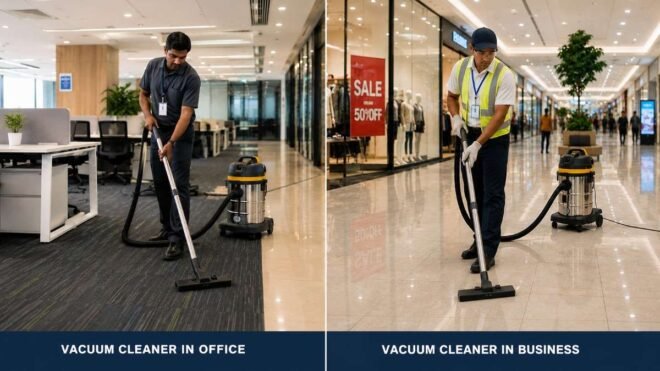
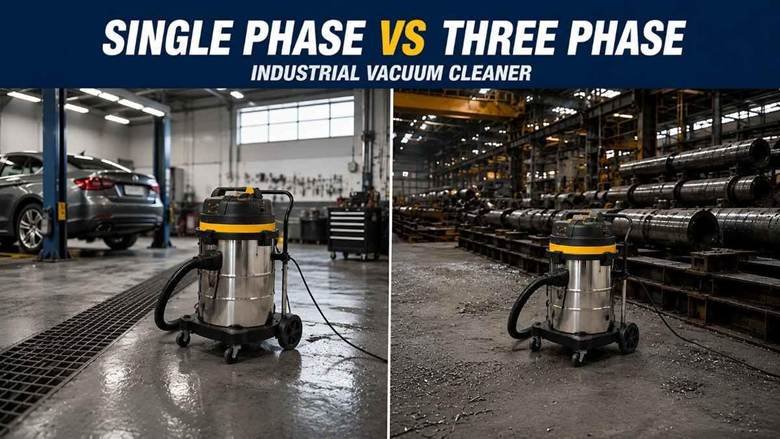
Housekeeping teams need something one person can carry up a service stair. A commercial vacuum cleaner on single phase, with a quiet motor and a long lead, fits guest corridors and ward floors better than anything larger. Noise matters more than raw suction in occupied spaces, and a 78 dB machine outside a patient room is not acceptable at night.
Factories, Foundries and Cement Handling
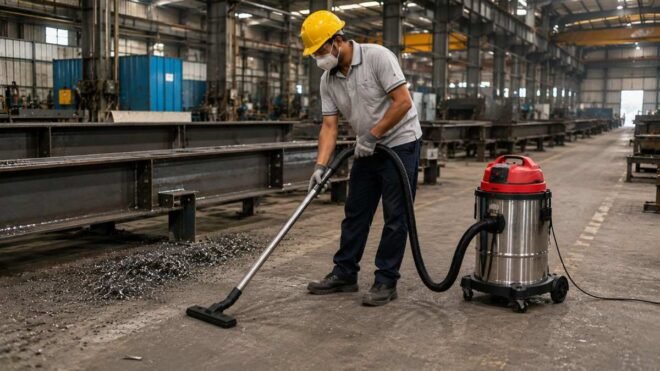
Where the dust is constant, abrasive or hot, a heavy-duty industrial vacuum on three-phase is the only sensible choice. An industrial vacuum machine tied into the process, running whenever the line runs, pays back in reduced housekeeping labour and fewer stoppages. Foundries and grinding shops in particular chew through single-phase motors.
Warehouses and Mixed Sites
Larger warehouses often end up with both: a single-phase unit for spot cleaning and mezzanines, plus a fixed three-phase installation at the packing lines. Splitting the job across two machines usually costs less than buying one oversized unit that nobody wants to drag around.
Deciding Between Single Phase vs Three Phase Industrial Vacuum Cleaner
Run through these before you commit:
1. Hours per day the machine will actually run, measured honestly.
2. Whether it stays in one place or moves between buildings.
3. Distance from the nearest three-phase board.
4. Whether the debris is abrasive, hot, wet or combustible.
5. Who maintains it, and whether brush replacement is realistic for them.
6. Whether noise in occupied areas is a constraint.
If four or more of that point toward continuous, fixed, heavy work, buy three-phase. If they don’t, a well-built single-phase machine will serve you for years and cost a fraction of the installed price.
Frequently Asked Questions
Can I run a three-phase vacuum from a single-phase supply?
Not directly. A variable frequency drive or a phase converter can generate three-phase from single-phase, but sizing one for a 5.5 kW blower is rarely economical, and it introduces a component that can fail. If you only have single-phase available, buy a machine designed for it.
Which is better for a small workshop, single phase vs three phase industrial vacuum cleaner?
For a workshop running one or two hours of cleaning a day, single phase wins on cost, flexibility and simplicity. Three-phase only makes sense if you plan to connect the unit permanently to a machine tool or dust hood that runs alongside production.
Do three-phase machines have more suction?
Usually more sustained suction rather than a higher peak figure. A side-channel blower holds vacuum pressure across long ducting and as filters load, where a bypass motor tails off. Compare quoted airflow and vacuum pressure together, not motor kilowatts, because kW alone tells you very little.
How long do carbon brushes last on a single-phase unit?
Commonly a few thousand running hours, though hot conditions and frequent starts shorten that. Keeping a spare set on the shelf costs little and avoids a machine sitting idle for weeks. Brushes are a maintenance item, not a fault, so budget for them from day one.
Conclusion
The honest answer to Single Phase vs Three Phase Industrial Vacuum Cleaner is that duty cycle decides it. Occasional cleaning across changing locations points to a single-phase unit you can plug in anywhere. Shift-long running, long duct runs and abrasive dust point to three-phase, with the installation cost budgeted from the start rather than discovered afterwards. Buying a large machine for a small job wastes capital and floor space. Buying a small machine for a large job just moves the cost into replacement motors. SGT Multiclean Equipments can help you match the machine capacity to your site’s actual cleaning requirements. If you’re unsure which side your site falls on, talking to an experienced supplier like SGT Multiclean Equipments through your actual cleaning hours and supply layout will help settle it quickly.