 ₹ INR

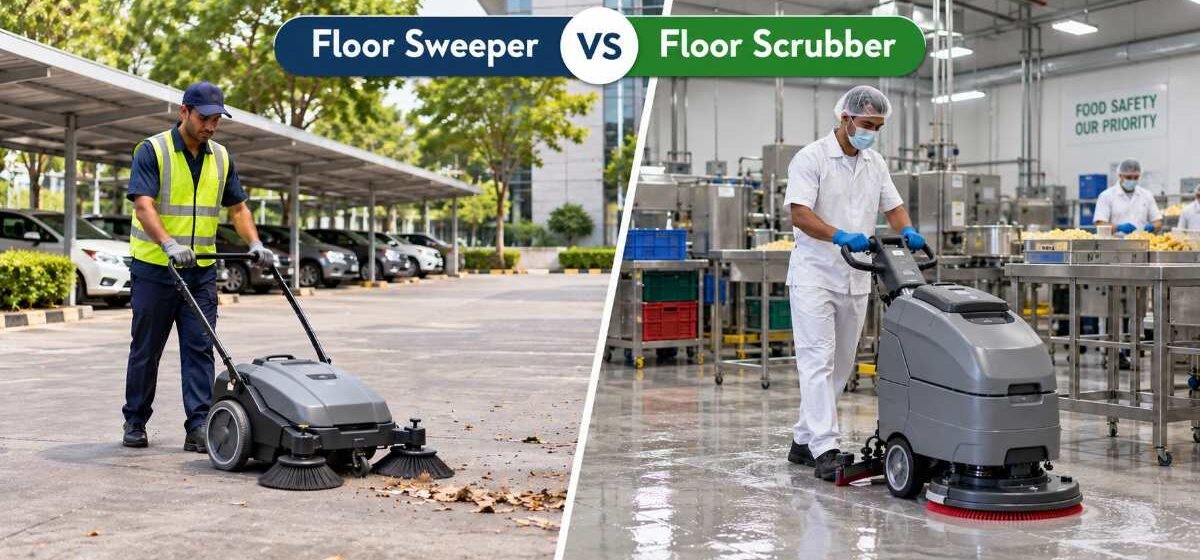
A packaging plant near Peenya bought a scrubber dryer, ran it for six weeks, then called about squeegee blades that kept shredding. Nobody had told them their floor carried cardboard dust, strapping offcuts and pallet splinters, and that scrubbing all of that into a recovery tank was never going to work. The Floor Sweeper vs Floor Scrubber question had been skipped entirely. SGT Multiclean Equipments can help facilities choose the appropriate cleaning equipment for their floor conditions.
It’s a common mix-up, because both machines are sold as floor cleaning solutions and both look similar in a catalogue. They solve different problems. One handles dry debris, the other handles stuck-on soil, and buying the wrong one first costs you money twice. SGT Multiclean Equipments offers cleaning equipment options for different commercial and industrial cleaning requirements.
What a Floor Sweeper Actually Does
A sweeper is a dry machine. A cylindrical main brush throws debris into a hopper, side brooms pull dirt in from edges, and a filter holds back the dust the brushing kicks up. Nothing gets wet. You empty the hopper, shake the filter, and carry on.
Brushes, hoppers and filtration
Working widths run from about 550 mm on manual push models to 1,600 mm on large ride-ons. Hopper capacity decides how often you stop, from around 20 litres on compact units to over 100 litres on an industrial floor sweeper. Filtration separates a good machine from a cheap one, and on any site with fine dust it matters more than brush width.
A commercial floor sweeper handles what a mop cannot: sand, gravel, leaves, packaging waste, metal swarf, wood shavings and the debris that collects around loading bays. Push it down a warehouse aisle and you’ll fill a hopper before the end.
What a Floor Scrubber Machine Does Differently
A floor scrubber machine is a wet process. Solution goes down, brushes or pads scrub the surface under pressure, and a rear squeegee vacuums the dirty water straight back into a recovery tank. The floor is walkable within a minute or two, which is why hospitals, hotels and food plants rely on them.
Scrubbers remove what sweeping cannot touch: grease films, spills, tyre marks, biological soil and the grey haze that builds on tile over months. What they won’t do is pick up bulk dry debris. Feed a scrubber a floor full of grit and you’ll clog the vacuum, wear the blades and push muck into a slurry that dries as a film.
Floor Sweeper vs Floor Scrubber: The Practical Differences
| Factor | Sweeper | Scrubber |
| Removes | Dry debris and dust | Grease, films, stuck-on soil |
| Water used | None | 30–300 litres per tank |
| Leaves floor | Dry, visually clean | Washed and nearly dry |
| Working width | 550–1,600 mm | 430–1,200 mm |
| Indicative price | Rs 40,000–8,00,000 | Rs 2,00,000–20,00,000 |
| Best suited to | Warehouses, yards, car parks | Hospitals, retail, food, offices |
Read that first row twice. It settles most of the Floor Sweeper vs Floor Scrubber argument on its own, because the two machines are not alternatives so much as consecutive steps.
Dry Debris or Wet Soil? Read Your Own Floor
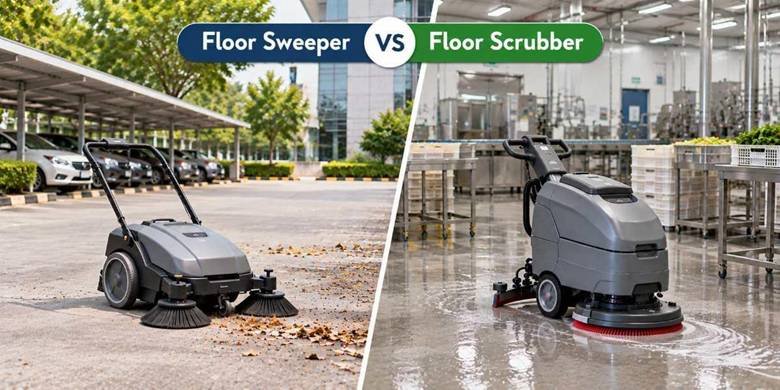
Walk your site at the end of a shift and look at what’s actually on the ground. The Floor Sweeper vs Floor Scrubber answer is usually obvious once you stop thinking in product categories and start looking at soil.
• Mostly loose debris and dust: you need a sweeper first
• Mostly marks, films and spills: you need a scrubber first
• Both, in volume: sweep, then scrub, in that order
• Fine powder or product spill: consider an industrial vacuum instead of either
Order matters more than people expect. Sweeping before scrubbing extends blade life noticeably and keeps the recovery tank cleaner, which protects the vacuum motor. Skip the sweep on a gritty floor and you’ll replace blades every quarter instead of twice a year.
Costs and Running Expenses of Floor Cleaning Equipment
Indicative ranges, dependent on size, build and specification:
• Manual push sweeper: Rs 40,000 to Rs 90,000
• Battery walk-behind sweeper: Rs 1,50,000 to Rs 4,00,000
• Ride-on sweeper: Rs 5,00,000 upward
• Walk-behind scrubber dryer: Rs 2,00,000 to Rs 6,00,000
• Ride-on scrubber: Rs 8,00,000 upward
Sweepers are cheaper to run. Main brushes and side brooms last months, filters need cleaning rather than replacing, and there’s no water, chemical or squeegee cost. Scrubbers consume detergent, blades, brushes and water every shift, and their batteries work harder because the vacuum runs constantly.
Set against that, a scrubber replaces far more manual labour. Any comparison of floor cleaning equipment should count labour hours saved, not just the invoice. A machine that costs twice as much but removes three people from a nightly mopping rota is the cheaper machine.
Framed that way, Floor Sweeper vs Floor Scrubber stops being a price question. A commercial floor sweeper covering a 20,000 sq ft yard in forty minutes replaces two staff with brooms who never finish properly anyway, at a fraction of a scrubber’s capital cost.
Floor Sweeper vs Floor Scrubber on Indian Sites
Local conditions push the answer in a particular direction more often than buyers expect.
Dust seasons and site realities
From roughly February to May, dust loading on any site with open shutters, a yard, or nearby construction climbs sharply. Warehouses, cement handling units, timber yards and logistics hubs generate dry debris continuously, which is exactly the duty an industrial floor sweeper is built for. On those sites, buying a scrubber first is the classic expensive mistake.
Monsoon flips it. Water, mud and slush come through every entrance between June and September, and that’s when a scrubber earns its keep. Many Bangalore facilities run both machines seasonally, leaning on one for half the year and the other for the rest.
Service, spares and operator reality
Ask where the nearest service engineer is based and how quickly a main brush, filter or blade reaches your city. Keep consumables on the shelf. Plan for operator turnover too: simple controls and clear labelling matter more than an extra 100 mm of working width.
When One Machine Isn’t Enough
Combination machines exist that sweep and scrub in a single pass, with a debris hopper ahead of the scrub deck. On large, mixed-soil floors like distribution centres and manufacturing halls, they save a full pass and one operator’s time.
They cost more, they’re heavier, and they need more maintenance because you’re running two systems in one chassis. For a mid-size unit, two separate machines are usually the better spend, and they give you redundancy when one goes in for service. Above roughly 10,000 sq m of mixed-soil floor, a combination commercial floor cleaning machine starts to make real sense.
If you go that route, check hopper size honestly against your debris volume. A combination commercial floor cleaning machine with a small hopper on a littered floor means constant stops, which cancels the pass you were trying to save.
Frequently Asked Questions
Can a scrubber pick up dry debris?
Not reliably, and it isn’t designed to. Small amounts of light dust will end up in the recovery tank, but anything solid clogs the vacuum path, shreds squeegee blades and turns fine dust into slurry. Sweep first on any floor carrying grit, packaging waste or swarf, then scrub.
Which should a warehouse buy first?
On Floor Sweeper vs Floor Scrubber grounds, most warehouses should start with the sweeper. Dry debris dominates, the machine is cheaper, and it covers ground fast. Add a scrubber later for washing bays, canteen areas and any floor where oil builds up and sweeping alone leaves marks behind.
Do sweepers work outdoors?
Yes, and it’s one of their strengths. Ride-on and heavy walk-behind sweepers handle car parks, loading yards, driveways and factory approach roads well. Check the tyres, ground clearance and filter class for outdoor duty, since dust on open ground is finer and heavier than most indoor floors produce.
Is a combination machine worth the money?
On large floors with both dry debris and stuck-on soil, often yes, because you clean in one pass instead of two. On smaller or single-soil sites the added cost and maintenance rarely pay back, and two dedicated machines give you more flexibility and a spare when one needs service.
Conclusion
The Floor Sweeper vs Floor Scrubber decision comes down to what’s genuinely lying on your floor at the end of a shift. Dry debris, dust and packaging waste call for a sweeper, and no amount of scrubbing power substitutes for it. Films, spills, grease and foot traffic marks call for a scrubber. SGT Multiclean Equipments offers cleaning equipment options to help you choose based on your site’s specific cleaning requirements. Plenty of sites need both, run in that order, and get considerably longer machine life for doing so. Look at soil type first, then area, then budget. If you’re weighing up your options, walking an experienced supplier like SGT Multiclean Equipments through your site and asking for a demo on your own floor is the fastest way to get a clear answer.