
 ₹ INR


Your housekeeping supervisor wants a new machine. The 2,000 sq m warehouse aisle takes four staff most of a shift to mop, and it still looks streaky by 11 am. So the question lands on your desk: Auto Scrubber vs Single Disc Machine, and which one earns its keep? SGT Multiclean Equipments can help you evaluate the right cleaning solution for this kind of demanding application.
It’s a fair question, and the honest answer isn’t the same for every site. One machine cleans fast and leaves the floor dry behind it. The other is slower but far more versatile, handling scrubbing, stripping, polishing and carpet shampooing from one body. Choose wrong and you either park an expensive asset in a corner or keep your team mopping past midnight. SGT Multiclean Equipments offers cleaning equipment options to help you match the machine to your site’s actual requirements.
What an Auto Scrubber Machine Actually Does
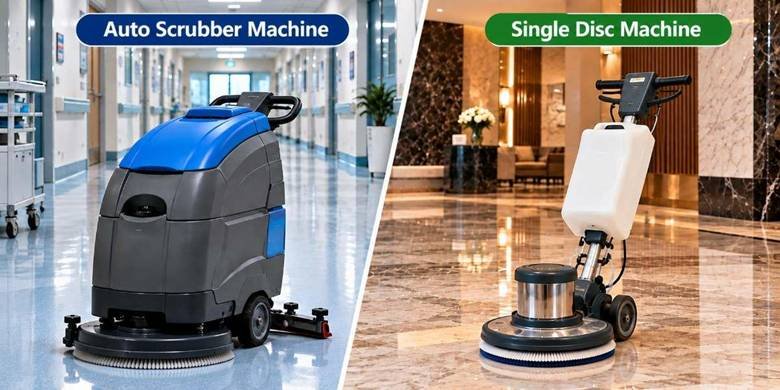
An auto scrubber machine does three jobs in one pass. It lays down a metered amount of solution, scrubs with rotating brushes under downward pressure, then vacuums the dirty water back through a trailing squeegee. The floor behind it is damp at worst and walkable within a minute. That matters more than buyers expect, because wet-floor downtime in a hospital corridor costs you something real even when nobody slips.
The scrub-and-recover cycle explained
Solution flows from a clean-water tank, typically 40 to 100 litres on walk-behind models. Brush pressure runs from around 20 kg on compact units to 45 kg or more on heavier machines, and that pressure does most of the cleaning. Scrub widths of 500 mm to 850 mm give rated productivity of roughly 1,500 to 4,000 sq m per hour. Treat those numbers with suspicion. On a cluttered shop floor with racking legs and doorways, real output lands at 50 to 60 percent of the brochure figure.
Batteries decide the rest. A 24V system with 100 to 150 Ah gives two to three and a half hours of continuous scrubbing. Lithium packs cost more but charge faster and tolerate top-up charging during breaks, which suits three-shift plants better than flooded lead-acid.
Where a Single Disc Machine Still Beats Everything Else
A single disc machine is a simpler animal. One motor, one gearbox, one rotating disc, usually 17 or 20 inches across, spinning between 154 and 180 rpm. Change the drive board or pad holder and the same body will scrub, strip wax, polish, buff or shampoo carpet. There’s no recovery tank, so you mop or wet-vacuum afterwards.
That sounds like a downgrade until you try to clean a hotel bathroom block or twelve-year-old grout lines with a ride-along machine. Weight and aggression win in those places. A single disc machine loaded with a black pad and a proper stripper lifts old wax that a scrubber’s brushes glide across.
Pads, brushes and floor polishing machine duty
Pad choice changes what the machine is. The colour code is fairly standard across brands:
• White pad: light buffing on sealed stone or marble
• Red pad: routine spray cleaning and light scrubbing
• Blue or green pad: heavier scrubbing on vinyl, ceramic and concrete
• Black pad: wax stripping, always with a stripper and slow passes
• Diamond pads: honing and restoring gloss on marble and granite
Set up as a floor polishing machine, the same unit that scrubbed a kitchen last week brings shine back to a marble lobby. Few machines are that flexible for the money.
Auto Scrubber vs Single Disc Machine: Head-to-Head Comparison
| Factor | Auto Scrubber | Single Disc |
| Rated output | 1,500–4,000 sq m/hr | 250–400 sq m/hr |
| Drying | Recovers water in the same pass | Needs mopping or wet vac |
| Versatility | Scrub and dry only | Scrub, strip, polish, buff |
| Power | 24V battery | Single-phase, 1.1–1.5 kW |
| Training | About an hour | A day; torque steering |
| Indicative price | Rs 2,00,000–6,00,000 | Rs 45,000–1,20,000 |
| Consumables | Brushes, blades, batteries | Pads, drive boards |
Area speed favours one machine and flexibility favours the other. In the Auto Scrubber vs Single Disc Machine argument, most mature facilities eventually stop arguing and run both.
Cost and Running Expenses of a Commercial Floor Scrubber
Purchase price is the number everyone fixates on, and the least useful. Work out cost per square metre per year instead.
Take a 3,000 sq m distribution centre cleaned daily. Manual mopping at roughly 200 sq m an hour needs about 15 labour hours. A commercial floor scrubber with a 600 mm deck covers it in two to three hours with one operator. Even allowing for battery replacement every three to four years at Rs 40,000 to Rs 80,000, plus blades and brushes, the labour saving usually repays a walk-behind machine inside 18 to 30 months.
A single disc unit won’t give you that arithmetic, because it doesn’t remove the drying step. What it gives you is a Rs 60,000 machine that handles five jobs and fits in a cupboard. For a 400 sq m clinic, that’s the smarter spend.
Matching the Floor Cleaning Machine to Your Site
The right floor cleaning machine follows the floor, not the budget. A few honest matches:
1. Warehouses, factories and malls above 1,500 sq m: auto scrubber, walk-behind or ride-on by aisle width.
2. Hotels and hospitals with mixed flooring: single disc first, scrubber later for corridors.
3. Food processing units: scrubber with chemical-resistant brushes, since slip risk makes water recovery essential.
4. Showrooms and lobbies in polished stone: a single disc with diamond pads wins outright.
5. Buildings with small lifts: measure the lift door before ordering anything.
Grout depth and soil type should drive brush selection. Rough kota stone needs stiffer bristles; vitrified tile does better on pads.
Auto Scrubber vs Single Disc Machine in Indian Facilities
Local conditions shift the calculation. Dust loading on Indian industrial floors is high, so sweeping before scrubbing isn’t optional. Skip it and you’ll be pulling grit out of the recovery tank and buying blades every quarter. Hard water is another quiet cost, leaving white film on dark floors unless dosing is corrected.
Then there’s service. A machine is only as good as the nearest engineer and the spare blade on the shelf. Ask how long a vacuum motor takes to reach your city, and get the answer in writing. Operator turnover argues for simple controls and clear labelling. Monsoon months bring mud through every entrance, so good matting cuts your scrubbing workload noticeably.
A Buying Checklist Before You Release the Order
• Measure the narrowest doorway, aisle and lift on the route.
• Ask for a demo on your dirtiest floor, not a showroom sample.
• Confirm run time on a full charge under load, not on paper.
• Check blade, brush and battery prices, which define five-year cost.
• Verify AMC scope: cover, response time, labour and travel.
Frequently Asked Questions
Which machine cleans faster on a large floor?
An auto scrubber, comfortably. It covers roughly six to ten times the area per hour of a single disc unit and lifts the water in the same pass, so there’s no separate drying step. On floors above about 1,500 sq m cleaned daily, that speed gap dominates every other factor in the comparison.
Can a single disc machine polish marble properly?
Yes, with the right setup. Fitted with diamond or grit pads and run at low speed, it hones and restores gloss on marble, granite and terrazzo. Heavy grinding and deep scratch removal still need a dedicated stone machine, but for routine shine maintenance a single disc unit does the job well.
Do I need three-phase power for these machines?
Usually not. Most single disc machines run on standard single-phase 230V supply, and battery scrubbers charge from a normal socket. Larger ride-on scrubbers and some industrial models may ask for heavier supply or a dedicated charging point, so confirm the electrical requirement before the machine reaches site.
Is it worth buying both types of machine?
For facilities above roughly 2,000 sq m with mixed flooring, often yes. The scrubber handles daily bulk cleaning of open areas, while the smaller unit covers washrooms, edges, stripping and periodic polishing. Together they cost less than forcing one machine to do everything badly.
Conclusion
Deciding Auto Scrubber vs Single Disc Machine comes down to two questions: how much open floor do you clean every day, and how many different cleaning jobs does that floor demand? Big, repetitive, time-pressured areas reward the scrubber’s speed and water recovery. Smaller mixed sites, or any building where polishing and stripping matter as much as washing, get better value from the simpler machine.
Look past the sticker price to consumables, service response and the labour hours you’ll genuinely save. If you’re weighing up your options, walking a supplier like SGT Multiclean Equipments through your floor plan and asking for a demo on your own site is the fastest way to get an answer matched to your situation. SGT Multiclean Equipments can help you evaluate the options based on your specific cleaning requirements.