 ₹ INR

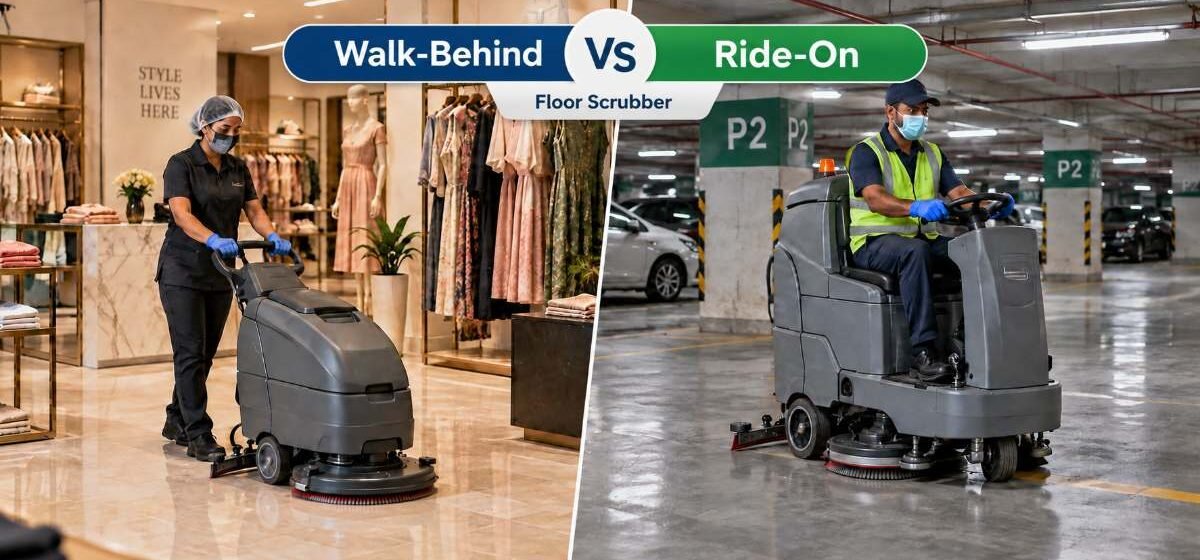
The quote lands and the gap is uncomfortable. One machine is Rs 3.2 lakh, the other is Rs 11 lakh, and both claim to clean your floor. If you’re stuck on Walk-Behind vs Ride-On Floor Scrubber, the sales pitch won’t settle it. The answer depends on aisle width, shift pattern and how many square metres one operator must cover before the shift ends. SGT Multiclean Equipments can help you assess the right floor cleaning solution for your site.
Here’s the short version. Under roughly 3,000 sq m a day, the walk-behind wins on total cost. Above about 8,000 sq m, the ride-on wins so clearly that arguing about capital cost is a false economy. In between is where the real decision lives. SGT Multiclean Equipments offers cleaning equipment options to match different floor areas and operational requirements.
What a Walk-Behind Floor Scrubber Does Best
A walk-behind floor scrubber puts the operator behind the machine, steering with a handlebar. Deck widths run 430 mm to 800 mm, tanks hold 30 to 100 litres, and rated productivity lands between 1,200 and 3,500 sq m per hour. Compact models weigh under 100 kg and fit in a passenger lift.
That last point decides more purchases than any spec sheet. Multi-floor offices, hospitals and hotels move machines between levels constantly, and one that won’t fit the lift stays on a single floor.
Where the walk-behind is genuinely better
Tight areas. Aisles under about 1.8 m, retail floors with fixtures, kitchens, corridors and anywhere the route involves doorways every twenty metres. A ride-on’s turning circle becomes the bottleneck, and the operator reverses more than cleans.
Traction-drive versions add a driven wheel, which matters on ramps and long runs. Pure push models are cheaper but tiring over a full shift, and tired operators cut corners.
One advantage rarely shows up in a Walk-Behind vs Ride-On Floor Scrubber comparison: storage. A compact commercial floor scrubber lives in a housekeeping room next to the mop sink. A seated machine needs a parking bay with a charging point, ventilation and clearance to drive in and out, which many older buildings don’t have spare.
Where a Ride-On Floor Scrubber Pays For Itself
A ride-on floor scrubber seats the operator, which changes the economics entirely. Deck widths of 700 mm to 1,200 mm, tanks of 100 to 300 litres, and rated output of 3,500 to 8,000 sq m per hour mean one person can cover ground that would take three on foot.
The productivity arithmetic
Consider a 20,000 sq m warehouse cleaned nightly. At a realistic 1,800 sq m per hour with a walk-behind, that’s roughly 11 machine hours, so two or three operators and two machines. A ride-on at 4,500 sq m per hour does it in under five hours with one operator. Over a year, the labour difference alone typically covers the price gap.
Ride-ons also stop less. Larger tanks mean fewer trips to the drain point, and that dead time adds up faster than buyers estimate. Where a walk-behind operator refills four times a shift, a ride-on may manage on one.
Walk-Behind vs Ride-On Floor Scrubber: Specifications Compared
| Factor | Walk-Behind | Ride-On |
| Deck width | 430–800 mm | 700–1,200 mm |
| Solution tank | 30–100 L | 100–300 L |
| Realistic output | 1,200–2,500 sq m/hr | 3,500–6,000 sq m/hr |
| Minimum aisle | About 1.5 m | About 2.5 m |
| Indicative price | Rs 2–6 lakh | Rs 8–20 lakh |
| Lift transport | Usually possible | Rarely |
Read the aisle row carefully. It disqualifies more ride-on purchases than price ever does.
Cost of Ownership Over Five Years
Capital cost is one line in a longer sum. A commercial floor scrubber’s five-year cost includes batteries, brushes, blades, service visits and the labour hours it saves or fails to save.
• Batteries: Rs 40,000 to Rs 1,50,000 per replacement, every three to four years
• Brushes and pad drivers: annual replacement on daily use
• Squeegee blades: two to four sets a year on gritty floors
• AMC: roughly 5 to 10 percent of machine value per year by scope
Where the two diverge is labour. A ride-on’s higher purchase price buys operator hours back every single day, so it amortises quickly on large floors and never amortises at all on small ones. Strip the Walk-Behind vs Ride-On Floor Scrubber debate down and that’s the entire argument in one sentence.
Site Conditions That Actually Decide It
Before comparing brochures on Walk-Behind vs Ride-On Floor Scrubber options, walk your own route with a tape measure. The things that kill a purchase are physical, not financial.
1. Narrowest aisle and doorway on the route, measured, not estimated
2. Ramps and gradients, since a heavy machine needs traction drive and braking
3. Floor obstructions like pallet corners, drain channels and expansion joints
4. Charging point location and whether cables would cross a walkway
5. Lift dimensions and load rating if the machine changes floors
6. Storage space, because a ride-on needs a bay, not a cupboard
An industrial floor scrubber in a foundry or a cement plant faces a different problem again: abrasive dust that eats blades and bearings. There, sweeping first and specifying a heavier-duty automatic floor cleaning machine matters more than deck width.
Walk-Behind vs Ride-On Floor Scrubber in Indian Facilities
Two local realities shape the choice. The first is operator availability. Where labour is comparatively affordable, the payback maths for a ride-on stretches longer than it would in Europe, which pushes many mid-size plants toward two walk-behinds instead of one ride-on. That’s often the correct call, and it also gives you redundancy when one machine goes in for service.
The second is floor condition. A lot of Indian industrial flooring is uneven, patched, or has open drains and joints. Ride-ons travel harder over those, blades wear faster, and operators feel every bump for eight hours. Any industrial floor scrubber working on rough concrete needs stiffer brushes and a spare set of blades on the shelf, and walk-behinds are simply more forgiving on that ground.
Dust is the other factor. Between March and May, an automatic floor cleaning machine on an open warehouse floor picks up far more grit than the same unit in a sealed pharma plant, and your consumable budget should reflect that.
Service response is the tiebreaker nobody puts in the table. A ride-on down for three weeks waiting on a controller is worse than two smaller machines, one of which always works. Ask about spare availability in your city, and get response times in writing.
A Practical Buying Checklist
• Demo both types on your dirtiest floor, in your actual aisles
• Time a full cleaning cycle rather than trusting rated output
• Confirm run time on one charge with brushes and vacuum loaded
• Check squeegee, brush and battery prices before signing
• Ask who trains your operators, and how often refreshers happen
• Confirm the AMC covers labour, travel and response, not just parts
Frequently Asked Questions
At what floor size does a ride-on make sense?
In the Walk-Behind vs Ride-On Floor Scrubber comparison, above roughly 5,000 sq m cleaned daily the seated machine starts to pay back, and above 8,000 sq m it’s clearly the better buy. Below 3,000 sq m the walk-behind wins on total cost and fits places the larger machine cannot reach.
Can one operator manage a ride-on safely?
Yes, with proper training. Most machines have speed limiting, automatic braking and reversing alarms. The real risks are pedestrian traffic and blind corners, so set cleaning schedules outside peak movement, mark routes clearly, and treat the machine as a workplace vehicle rather than a cleaning tool.
Do both types need the same maintenance?
Broadly yes: brushes, squeegee blades, filters, tank rinsing and battery care. Ride-ons add steering, traction motor and seat-switch checks, and their larger battery banks cost more to replace. Daily tank rinsing is the single habit that prevents the most expensive failures on either machine.
Is a walk-behind machine too slow for a warehouse?
Not necessarily. A 700 mm traction-drive model handles a 5,000 sq m warehouse comfortably within a shift. The problem starts when floor area grows or cleaning windows shrink. If your team is finishing late every night, that’s the signal to move up rather than buying a second small machine.
Conclusion
The Walk-Behind vs Ride-On Floor Scrubber question resolves once you stop comparing price tags and start comparing square metres per operator hour. Measure your narrowest aisle, count the area you clean daily, and work out how long your cleaning window really is. Small and tight sites are better served by the walk-behind, which costs less, fits everywhere and is cheaper to keep running. SGT Multiclean Equipments can help you evaluate the right machine based on your site’s cleaning requirements.
Large open floors under time pressure justify the seated machine several times over. Demo both on your own floor before deciding. If you’re weighing up your options, talking through your layout with an experienced supplier like SGT Multiclean Equipments is the fastest way to get an answer matched to your building.